

Climate change is a crisis that may seem too big for any individual to influence. We have numerous industries driving global emissions, corporations dominating the global supply chains and governments controlling energy policies.
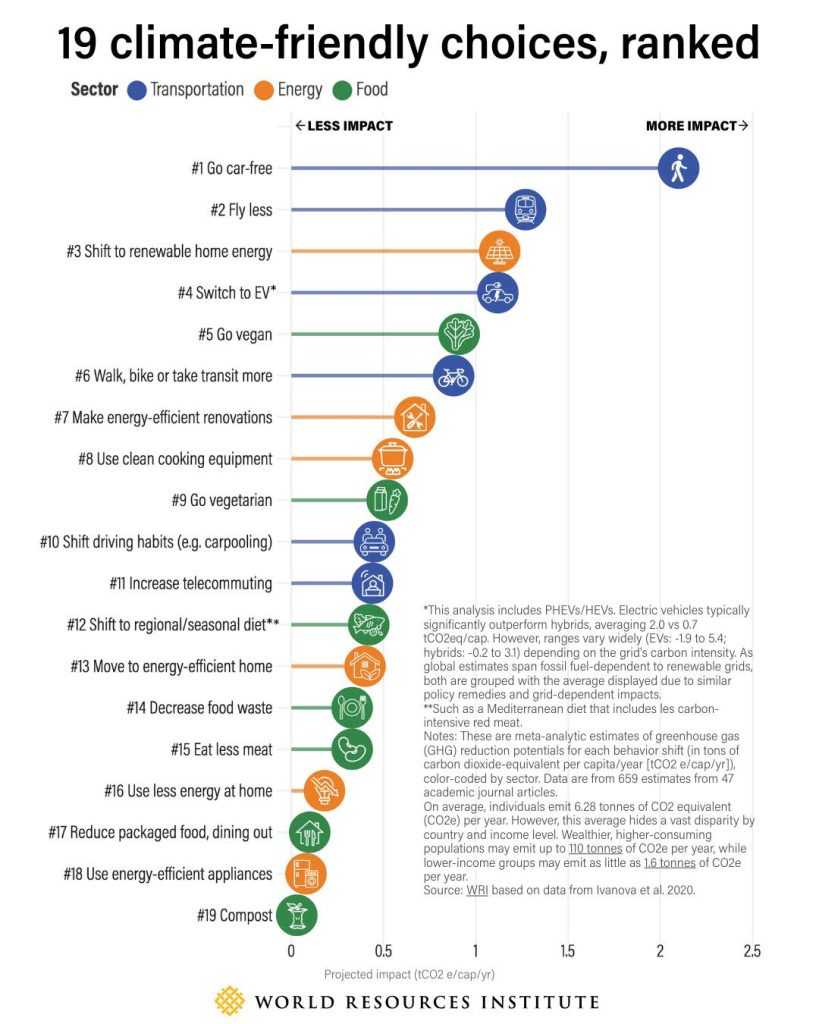
While global action is crucial, a new analysis by the World Resources Institute (WRI) shows how the choices we make everyday can impact our daily lives if millions of people act together. WRI lists 19 climate-friendly lifestyle choices ranked by their potential to reduce greenhouse gas emissions:
1. Go Car-Free
Choosing not to drive significantly cuts emissions from fuel use, car manufacturing, and maintenance.
2. Fly Less
Air travel is among the highest-emission activities per trip, so flying less dramatically lowers your footprint.
3. Shift to Renewable Home Energy
Switching to solar or other renewables reduces reliance on fossil-fuel electricity.
READ MORE: How Can China Deliver on Its 2060 Carbon Neutrality Goal?
4. Switch to an Electric Vehicle (EV)
Driving an EV lowers emissions, especially in regions powered by clean energy.
5. Go Vegan

A fully plant-based diet removes the high climate cost of livestock and dairy production.
6. Walk, Bike, or Take Transit More
Replacing car trips with low-carbon transport reduces emissions and eases congestion.
7. Make Energy-Efficient Renovations
Improving insulation, windows, and heating systems reduces home energy use.
8. Use Clean Cooking Equipment
Switching from charcoal or gas to electric or induction stoves reduces pollution and emissions.
9. Go Vegetarian
Eliminating meat (while still consuming dairy/eggs) lowers your food-related carbon footprint.
READ MORE: Kenya’s Top 25 Influential Female Climate Champions to Watch in 2025
10. Shift Driving Habits (e.g., Carpooling)
Carpooling and efficient driving reduce fuel use and emissions.
11. Increase Telecommuting
Working from home reduces daily commuting emissions.
12. Shift to a Regional/Seasonal Diet
Choosing locally grown, seasonal foods cuts transport and refrigeration emissions.
13. Move to an Energy-Efficient Home
Living in low-energy buildings reduces heating, cooling, and electricity needs.
14. Decrease Food Waste
Planning meals and storing food properly prevents methane emissions from landfills.
READ MORE: Dosy Bikes Empowers Women and Drives Green Mobility in Middle East
15. Eat Less Meat
Reducing (not eliminating) meat consumption lowers livestock-related emissions.
16. Use Less Energy at Home
Turning off unused appliances and reducing heating/cooling cuts household emissions.
17. Reduce Packaged Food, Dining Out
Minimizing processed and packaged foods lowers emissions from manufacturing and waste.
18. Use Energy-Efficient Appliances
Upgrading appliances decreases long-term household power consumption.
19. Compost
Composting food scraps prevents methane production and enriches soil.
In a recent paper synthesizing findings from 47 academic studies, WRI ranked these 19 lifestyle actions by their greenhouse gas (GHG) reduction potential. The analysis builds on data from environmental researcher Diana Ivanova et al. (2020), highlighting how individual decisions around transportation, food, and home energy use can collectively shift the global emissions curve.
[Source: WRI based on Ivanova et al., 2020]