
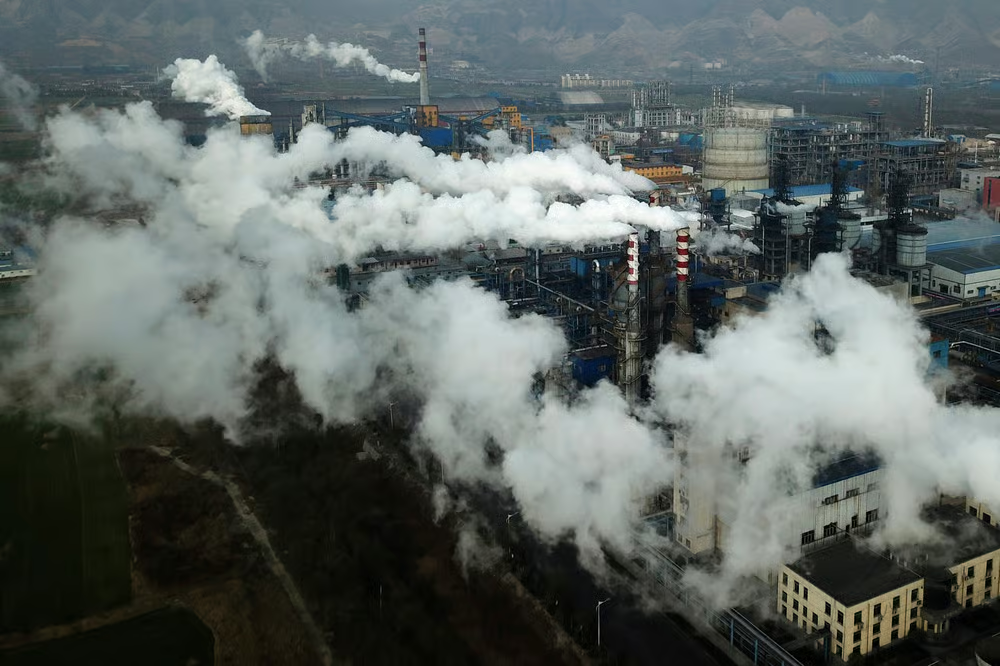
President Xi Jinping announced in 2021, announced that China will achieve carbon neutrality goal by 2060, a move that aims to balance greenhouse gas emissions with removals and reduce net emissions across all major sectors, including energy, industry, and transport. “We aim to have CO2 emissions peak before 2030 and achieve carbon neutrality before 2060,” President Xi said.
The commitment aligns with the Paris Agreement’s objective of limiting global temperature rise to 1.5°C.
However, the Climate Action Tracker (CAT) rates China’s Long-Term Strategy submitted to the UNFCCC in 2021 as “Poor,” stating a lack of binding interim targets, insufficient sectoral policies, and limited clarity on implementation timelines.
China is the world’s biggest source of carbon dioxide, responsible for around 28% of global emissions.
The country dominates the global clean energy supply chain, producing over 80% of solar panels, 60% of wind turbines, and 75% of electric vehicles and their batteries.
READ MORE: KenGen To Lead, Operationalize Kenya’s First Nuclear Plant
To meet the carbon neutrality goal by 2060 , China must take decisive action across several fronts.
First, the country needs to cut its reliance on coal, which still dominates power generation.Halting approvals of new coal plants, accelerating retirements of existing plants, and scaling up renewable energy deployment are crucial to prevent long-term carbon lock-in.
Second, decarbonizing energy-intensive industries such as steel, cement, aluminium, and chemicals will be key.China’s expansion of the national Emissions Trading Scheme (ETS) to cover these sectors by 2027 could help reduce emissions if stringent caps and allocation rules are enforced.
Additional measures, such as electrification and energy efficiency improvements, are also needed.
Third, mitigating non-CO2 greenhouse gases, especially methane, is essential.
READ MORE: Celebrating Influential Women in Kenya’s Energy Sector
While China’s 2035 climate targets include all greenhouse gases, experts stress that more focused policies are required to ensure measurable reductions.China’s rapid renewable energy expansion, leadership in electric vehicle production, and dominance in the global solar and wind supply chains provide a strong foundation.
In 2025, renewables accounted for nearly 40% of electricity generation, and installed wind and solar capacity has already exceeded 1,600 GW.However, the ongoing coal plant construction, high fossil fuel dependence, and industrial emissions growth remain significant obstacles.
Experts have advised that policy reforms, sectoral decarbonization, and stricter enforcement mechanisms will be critical for China to meaningfully contribute to global climate mitigation.